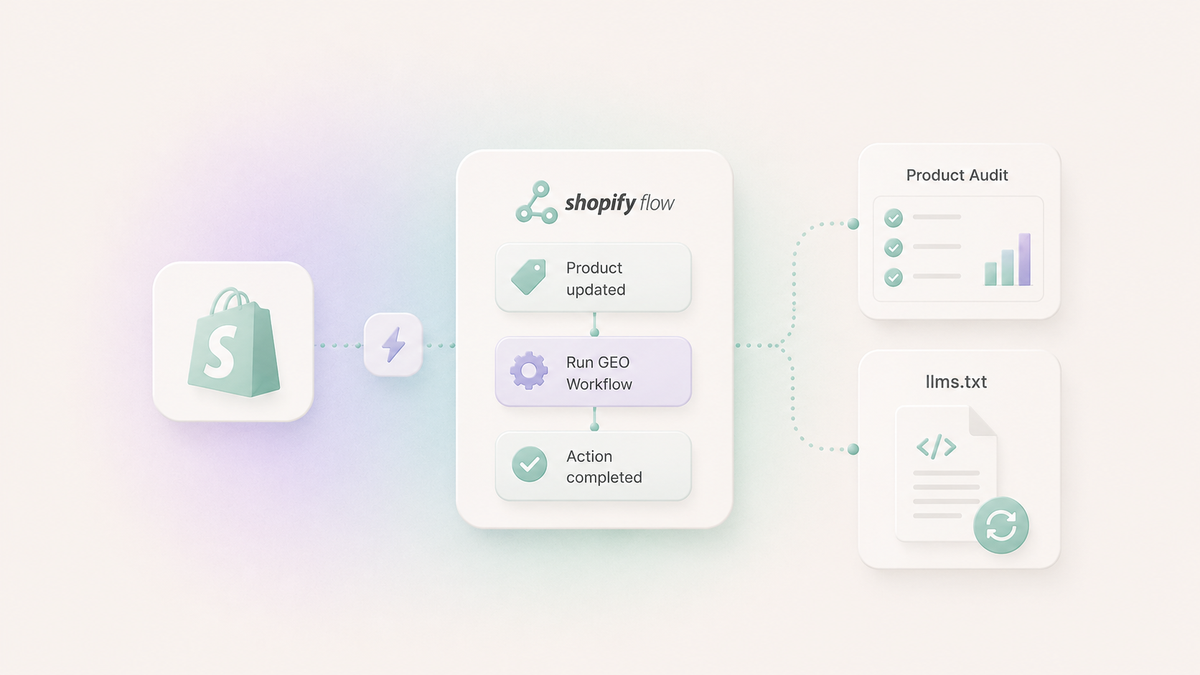
Shopify Flow Automation for GEO: How Shopify Brands Can Automate Product Audits and llms.txt Files
Shopify brands are entering a new phase of ecommerce growth. It is no longer enough to focus only on SEO, paid ads, and traditional content marketing. More shoppers are now discovering products through AI platforms such as ChatGPT, Gemini, Claude, and Perplexity AI.
This shift creates a new need for ecommerce brands: Generative Engine Optimization, also known as GEO.
GEO helps brands improve how AI systems understand, compare, and recommend their products. But for most Shopify merchants, GEO work has been difficult to scale because it depends on ongoing manual execution.
That is why Vizby launched a new feature that connects directly to Shopify Flow and allows merchants to automate GEO tasks that are part of the suggested action plan.
With this integration, Shopify users can automate tasks such as product audits and llms.txt file updates based on store events and triggers.
What Is Shopify Flow Automation for GEO
Shopify Flow automation for GEO allows a Shopify store to automatically trigger optimization tasks when specific events happen inside the store.
Instead of manually reviewing products or updating backend files, merchants can use automation to complete important GEO actions continuously in the background.
Examples of GEO automation include:
- Product audits triggered when a product is updated
- llms.txt file automation triggered when product data, collections, or store content changes
- Optimization workflows triggered when product information changes
This helps brands keep their AI visibility strategy active without relying only on manual work.
Why GEO Automation Matters for Shopify Brands
GEO is not a one-time task. AI search and recommendation systems rely on product clarity, structured information, credibility signals, and fresh supporting data.
For Shopify brands, product catalogs change constantly. Titles change. Descriptions change. Inventory changes. New collections launch. If GEO work is not updated continuously, AI platforms may rely on outdated or incomplete signals.
Automation solves that problem. By connecting GEO workflows to Shopify Flow, merchants can make optimization a repeatable system rather than an occasional project.
Key Benefits of Automating GEO Tasks with Shopify Flow
1. Faster execution
Shopify merchants do not need to manually carry out every suggested action. Once workflows are connected, important GEO tasks can run automatically based on store activity.
2. More consistent product optimization
When product pages are updated often, optimization work can fall behind. Automated product audits help stores maintain strong and consistent product data over time.
3. Better support for AI discovery
AI bots and answer engines work best when product information is clear, structured, and up to date. Automation ensures that signals remain accurate and easy to interpret.
4. Smarter backend maintenance with llms.txt files
llms.txt files play a critical role in helping AI crawlers understand what content exists on a site and how to navigate it. By automating llms.txt file updates, Shopify brands ensure that backend signals stay aligned with changes across products, collections, and site structure.
5. Less manual work for lean teams
Many Shopify merchants do not have large SEO or content teams. Automation reduces the workload required to maintain a strong GEO program.
6. Stronger long-term visibility
Because optimization is continuously running in the background, Shopify brands build a stronger foundation for being surfaced and recommended in AI-driven results.
Examples of GEO Tasks That Can Be Automated
A Shopify brand can use this feature to automate several important tasks from the suggested action plan.
One example is a product audit workflow. When a product is created or updated, the system can review whether the product content is detailed enough, specific enough, and structured clearly enough for AI systems to understand.
Another example is llms.txt file automation. When a store adds new products, updates collections, or changes important content, llms.txt files can automatically update to reflect the most accurate and relevant version of the site for AI crawlers.
These workflows help Shopify brands move from reactive optimization to continuous improvement.
The Impact on Shopify Users
For Shopify users, this feature has a direct impact on both operations and growth.
- It improves efficiency by removing repetitive manual tasks.
- It improves consistency by ensuring audits and backend updates happen continuously.
- It increases the likelihood that products are properly understood by AI systems, which supports stronger visibility in AI-driven discovery.
Most importantly, it gives Shopify merchants a scalable way to compete as more shopping journeys begin inside AI platforms.
GEO Is Becoming Infrastructure
The biggest shift here is not just automation. It is how Shopify brands think about GEO.
GEO is moving from isolated tasks into core infrastructure.
When GEO workflows are connected to Shopify Flow, optimization becomes part of the operating system of the store. That gives brands a long-term advantage as AI continues to influence how shoppers discover and choose products.
Conclusion
Vizby's integration with Shopify Flow allows Shopify brands to automate key GEO tasks such as product audits and llms.txt file updates.
This makes GEO easier to scale, easier to maintain, and more effective over time.
As AI continues to shape ecommerce discovery, Shopify brands that automate optimization early will be in a stronger position to be found, trusted, and recommended.