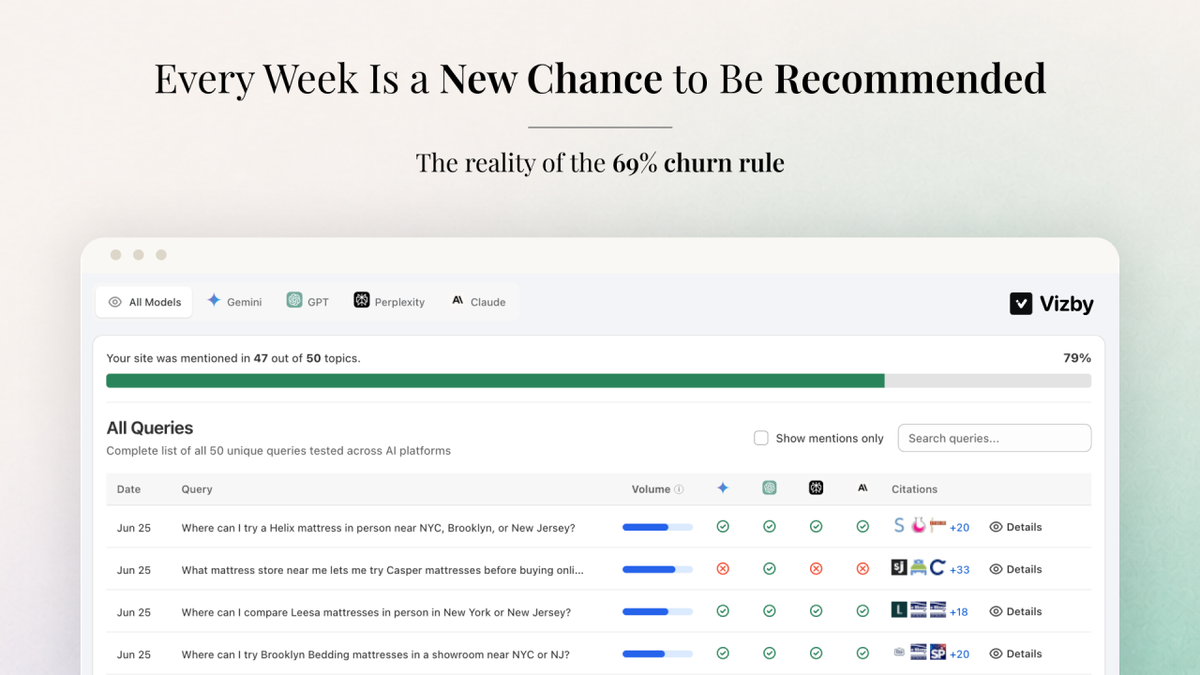
How Frequently Do AI Citations Change? The Reality of the 69% Churn Rule for Shopify Merchants
When Shopify merchants first start measuring their store's visibility in generative AI search, the diagnostic question they track is simple:Are our products showing up in the response?That question gives you a single snapshot. What it fails to tell you is whether your collections will still be showing up next week, or if your current visibility is merely a temporary wave in the model's retrieval layer. So we looked into what algorithmic volatility actually looks like for e-commerce.
To map the real-world lifespan of an AI product recommendation, we executed a comprehensive, quarter-long tracking study. We scaled our tracking across hundreds of e-commerce brands and thousands of transactional, non-branded consumer queries through four major platforms: OpenAI/ChatGPT Search, Google Gemini, Perplexity AI, and Anthropic Claude.
Our first core finding targets the fundamental nature of AI search real estate. The data completely dismantles the traditional idea of a permanent ranking position. In the age of AI, getting your store noticed is a fluid, probabilistic game governed by continuous algorithmic rotation across your product catalog and your site's copy.
So, how long does an AI citation actually last for a merchant?
The short answer: not long.
Key Takeaways
- Citations cycle fast:The overall e-commerce citation pool exhibits a55.9%turnover rate week-over-week, which expands to a68.6%total churn rate over a 90-day horizon.
- Visibility is a rolling probability:AI engines utilize routing layers that deliberately shake up product recommendations to test alternative web sources.
- Platform code dictates store presence:Baseline visibility rates vary significantly across engines, ranging from22.5%to45%across identical buyer prompt stacks.
- Catalog indexing alone isn't enough:Winning an AI recommendation reflects a single successful retrieval cycle; holding it requires a perfect mix of structured catalog data and dynamic blog content.
How We Measured E-Commerce Citation Stability
Every week for a full quarter, we ran thousands of conversational consumer prompts the exact type of questions shoppers ask when comparing products across hundreds of brands through ChatGPT, Gemini, Perplexity, and Claude. We captured every store URL cited, tracked the precise content layout of those product pages and blog posts, and measured how much the cited sources changed over time.
A stability baseline was established by running identical queries consecutively under identical parameters keeping user profile, location, and phrasing perfectly static—so we could see exactly how fast a merchant's presence erodes if they rely solely on a static Shopify theme setup.
Why Product Citations Rotate Out Across Tracking Cycles
The assumption that generative search engines maintain a stable, long-term leaderboard of recommended shopping links is a myth. Our three-month study confirmed that e-commerce citation consistency is a rolling probability rather than a locked ranking position.
When comparing our data tracking windows, we observed significant citation turnover. Our data shows an overall e-commerce citation pool churn rate of55.9%week-over-week, which steadily scales to a68.6%total rotation over the course of the quarter.
This churn rate accelerates sharply depending on the specific engine's code layer. On highly active, dynamic platforms, the product citation pool completely flips over the study's horizon:
- Google Gemini: 79.1%of unique citations rotated out entirely.
- Anthropic Claude: 79.3%of unique citations rotated out entirely.
More than two-thirds of specific store URLs rotate out across the long-term testing baseline, even when all external user variables remain completely unchanged. This high-frequency turnover is a core feature of how generative engines are architected to work.
The algorithms behind modern search pipelines use a routing layer that intentionally injects variance into their selection to discover alternative high-quality store options, fresh blog reviews, and diverse catalog matches. Because of this, you no longer "own" an organic search slot. Your Shopify store simply owns a rolling probability of being included in the next synthesis. Getting recommended today tells you that your content registered with that engine's retrieval layer; it tells you very little about whether you will be cited again next week.
Models Visibility Breakdowns for E-Commerce
This high-frequency citation churn is model-agnostic, but it varies sharply based on each platform's core retrieval code. Across our entire quarterly data matrix, a brand's average baseline visibility rate across identical conversational buyer query stacks broke down by engine:
- OpenAI / ChatGPT Search: 22.5%visibility rate across the query stack.
- Google Gemini: 30.0%visibility rate.
- Perplexity AI: 32.5%visibility rate.
- Anthropic Claude: 45.0%visibility rate.
The data highlights that different engines maintain different thresholds for variance. ChatGPT concentrates its citation footprints on a narrower pool of historically trusted domains. Conversely, Anthropic's Claude and Perplexity show a greater willingness to ingest and surface broader, diversified sets of multi-brand web sources.
Because the baseline market space is so distributed, the overall AI search leaderboard splits share across an interconnected loop of competing storefronts rather than allowing a single brand monopoly
The baseline churn rate remains high across all four engines, a merchant's presence is constantly cycling in and out. If your catalog info drops slightly in relevance scoring due to unoptimized product descriptions, or if a competitor updates their Shopify blog with deeper informational content, the system discards your page entirely and re-queries rather than serving a borderline citation.
What This Means for Your Shopify Store (Blog vs. Catalog Optimization)
To survive a search ecosystem governed by a68.6%long-term citation turnover, Shopify merchants must stop optimizing exclusively for search engine crawlers and start optimizing for the vector space of AI.
You must balance your optimization across two core pillars:Catalog ArchitectureandInformational Blog Content.
1. Catalog Optimization: Structuring for Machine Readability
AI search engines struggle to read unformatted, sparse text scattered across standard e-commerce templates. If your product pages only contain a price, a size selector, and three basic bullet points, they will fall out of the retrieval loop.
- Deploy Massive JSON-LD Schema:You must use schema tools to explicitly feed clean, machine-readable data directly to AI bots. Ensure your Product, Offer, and Inventory schema metadata are flawless so AI models can instantly verify pricing, stock, and variations.
- Deepen Product Descriptions with Semantic Context:Move past basic copywriting. Use unique, highly specific entity descriptors in your product fields. Instead of writing "modern gold shower door," anchor your text with structural properties like "matte brushed gold hardware, 10mm ANSI-certified tempered clear glass, and adjustable-width framing panels."
2. Website Blog Optimization: Feeding the AI Evidence Layer
Our broader research revealed a critical truth: AI models pull the vast majority of their recommendations from editorial libraries, buying guides, and educational tutorials—what we call theEvidence Layer. If you only have product listing pages, you are invisible during the consumer's research phase.
- Build a 100-Word "BLUF" Article Framework:AI chunking tools slice your Shopify blog posts into tiny pieces during search crawls. To prevent your articles from being cut off, ensure every major H2 or H3 heading (e.g., "How to measure for an adjustable shower door") is followed immediately by aBottom-Line-Up-Front (BLUF)direct answer of fewer than 100 words.
- Elevate Factual Signal Density:High-quality AI rerankers discard fluffy, repetitive content. Integrating concrete, attributed industry statistics and direct expert quotations into your Shopify blog articles yields up to a41% lift in AI citation probability.
FAQ
If citation churn is near 69% over the quarter, is optimizing my Shopify store for AI search actually worth it?
Yes. The68.6%churn tells us that individual URL selection fluctuates over time, but it does not mean the underlying themes change at that same scale. Merchants who consistently feed AI engines high-density, authoritative content maintain a high baseline probability of remaining in the consideration pool. You aren't optimizing to hold a static position; you are optimizing to ensure that whenever the wheel spins, your store has the maximum number of eligible, high-scoring text blocks in the pile.
Should I focus my budget on updating my product pages or writing Shopify blogs?
You need both, because they serve different layers of the AI search pipeline. YourShopify blog articlesact as theEvidence Layer—they provide the conversational, information-dense text that AI models use to decidewhichbrand to recommend. Yourproduct pagesact as theClick Layer—they provide the structured schema data the AI uses to generate the direct footnote links so users can complete the transaction.
How do we prevent competitors from stealing our e-commerce share of voice?
AI engines utilize strict quality rerankers that filter out low-density text. To protect your share, you must keep your top blog assets active by refreshing them within a rolling 12-to-18-month window. Update internal statistics, refresh the dynamic date-modified tags in your Shopify HTML header, and adjust titles to reflect current-year parameters. This signals to the AI's temporal classifiers that your content belongs in the freshest chronological bucket.